


Boards of Canada, Inferno

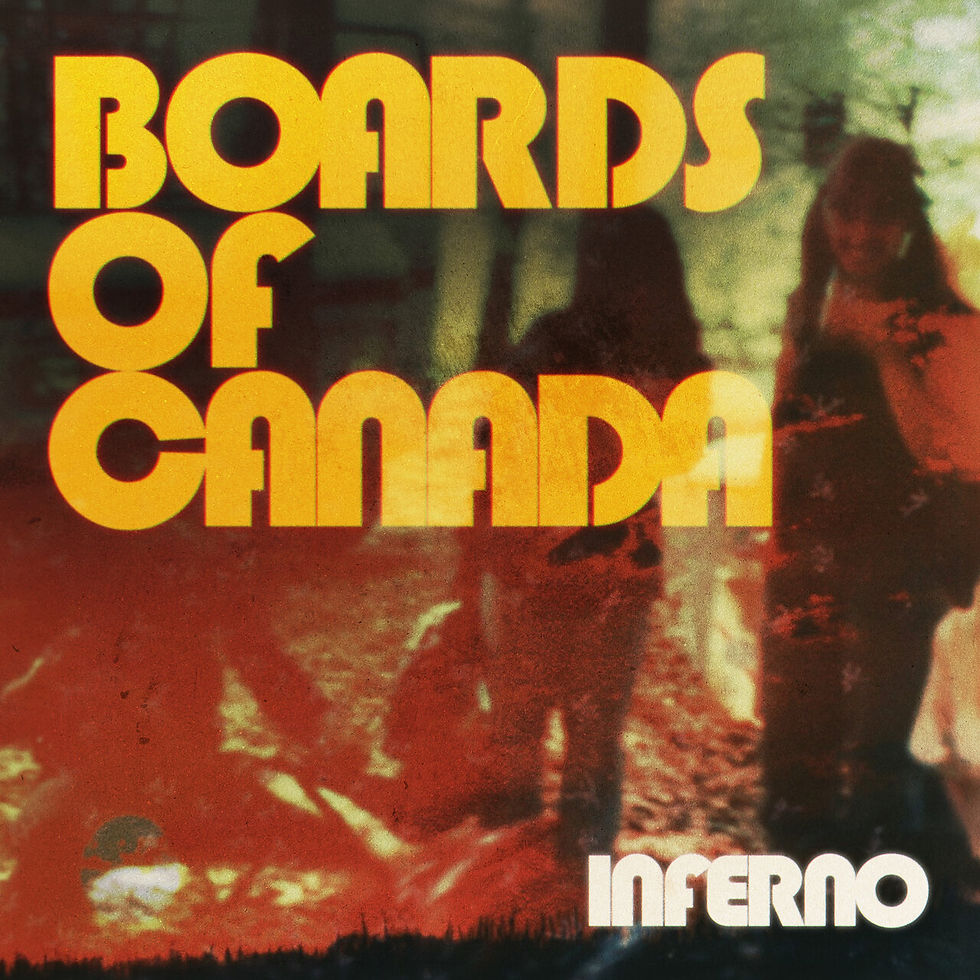
In retrospect, much of Boards of Canada’s oeuvre over the past 20-ish years has interrogated cynicism, innocence, and the bizarre intermingling of the two which defines adulthood. In their first album in 13 years, the Scottish duo make this possibly the most explicit it’s ever been, and in doing so return with something uncharacteristically cinematically surfaced, zeitgeist-textured, and (unique in their discography) viscerally angry. Ensconced and sculpted by their standard downtempo beats and murky synths, the narrative core of this sprawling project is fairly straightforwardly a meditation on the strangeness of religion, but also, in particular the strangeness of the mismatch between our technical abilities as a species and our capacity to think through their implications.
An early-album example of this might be “Hydrogen Helium Lithium Leviathan,” a neat little procedural zoom through a classic BoC dread-inducing synth warble closing on something which comes across as interchangeably imperious and hopeful (maybe encapsulated by a track title which could just as easily be a nod towards gnosticism as a simple joke arranging the first chemical ingredients of the early universe into hell). On “Father and Son,” in between eerie vocal manipulations and a slowly-building intrigue-laden beat, we hear a father’s incredulous kind of shock at his child’s conversion into a true believer in, well, something. In warping and reversing and stuttering select phrases the song starts to project something like a robotic face - cycling through emotions, flashing a smile, a frown, and so on, but doing so in a way we instinctively recognize as wrong. And, I mean, at a certain point the capacity any idea has to shape minds is a little unnerving, right?
One of Inferno’s definite highlights is the bombastic “Naraka,” a dynamic drive undergirded with a Hare Krishna chant and a dynamic sense of hopeful purpose which surfaces every now and then across the album (glimpses of this are faintly visible on “Blood in the Labyrinth” and “Deep Time” among others). Its inverse comes in the form of “All Reason Departs” later in the album, a shimmering slow digital tumble initiated by British occultist Alesteir Crowley describing an apocalyptic war, which ultimately dissolves into a brackish pixelated wave. In the wider grammar of the album the two songs don’t so much seem to represent opposites as separate reflections of the same thing.
But certain choices here do come across as more hokey than their previous project Tomorrow’s Harvest, and certainly much more of the album functions as inert set-dressing (which will probably live on for some time in the form of various social media reel sounds etc.) rather than meaningful bridges between moments. “Somewhere Right Now in the Future” was recently described by somebody as sounding like the music piped into the waiting line for a frightening theme park ride, “Memory Death” and “Acts of Magic” all somehow really do tap into a grim dread of the future while simultaneously sounding like someone making YouTube type-beat BoC imitations. Maybe a good encapsulation of this is the recent use of Deep Time in a Department of Homeland Security propaganda Tweet. It’s hard to come up with something more on-the-nose than the object of much of this album’s ire misreading the vibe and adapting this material for its own uses.
That said, something I’ve found myself returning to frequently, and by far the most directly uplifting moment on the album, is its third track "Age of Capricorn," which, while continuing a multi-decade zodiac sign narrative, also represents something legitimately new in their repertoire - a weary but obstinate hope, visible in the cracks between layered vocals and fraying synth pulses. When taken with the totality of the project, the digitally enhanced apocalyptic cultic narrative braided together in every track, the textbook Boards of Canada style cover art, and even the title Inferno, a strong haunting presence peering in on this album is millenarian Christianity, specifically Waco, TX, cult leader David Koresh, and the Branch Davidians. "Age of Capricorn’s" central vocal sample, other than a voice spelling out the name of Nostradamus’s predicted antichrist figure and a new age Hindu Yogic chant, is an eschatological televangelist prayer reflective of the same guiding ideology that led to the historic standoff in 1993. This isn’t the first time the standoff, the cult, and the symbol of the whole thing has held a fascination for the group - 2000’s In A Beautiful Place Out In the Country is theoretically entirely based around the event. But in the wider context of the album’s story - slow collapse, religious insanity, creeping dystopia, the hint of climate hell - it’s the first time it’s been framed as something afflicting the entire world.
BoC have been referred to as nostalgia-merchants of a sort, and while I think that might be overly reductive it certainly accurately describes a significant chunk of their technique as well as the cultural position they’ve come to occupy. Inferno points this in a different direction, or maybe it clarifies it - nostalgia, in its literal Greek translation represents the pain of returning home, maybe best understood as a broad awareness of the past in relation to the present. While this usually carries a sentimental warmth, it also by nature refers to the things we would like to forget but really, really should not.
'Inferno' the new album from Boards of Canada was released May 29th, 2026, via Warp Records


